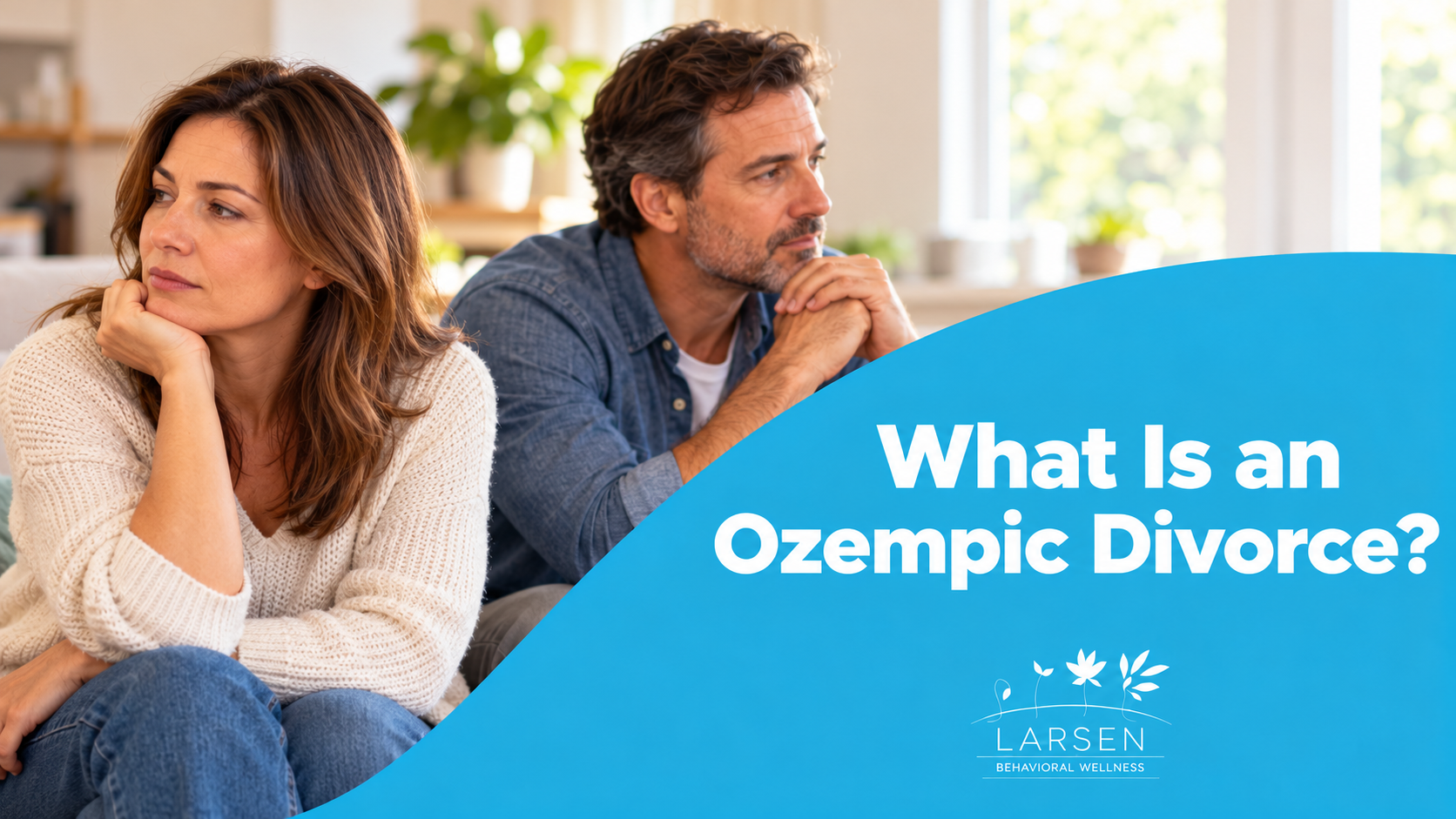
Have you or someone you know started Ozempic or another GLP medication, lost a significant amount of weight, and noticed that their intimate relationship suddenly feels different?
Maybe the couple is fighting more. Date nights have changed. One partner seems more social, confident, or independent, while the other feels insecure or left behind.
There’s a growing conversation about something people are calling the “Ozempic divorce.”
The term describes relationship strain or separation that develops alongside dramatic, medication-assisted weight loss. It isn’t a clinical diagnosis, and it doesn’t mean that taking a GLP medication will cause a divorce. It does point to a real issue that isn’t discussed enough: a major physical transformation can also bring psychological, social, and relational changes.
Those changes can affect the entire family, especially a spouse or long-term partner.
I’m Dr. Jessica Larsen, a licensed clinical psychologist and founder of Larsen Behavioral Wellness. We work with individuals and couples navigating major life transitions, including unexpected relationship changes that can come with physical transformation.
This article is educational. It isn’t medical advice about Ozempic or any other medication, and it isn’t a substitute for individualized couples therapy or clinical care.
Weight Loss Can Change More Than the Body
By now, most of us have seen or heard about someone experiencing a dramatic physical transformation after taking a GLP medication such as Ozempic, Wegovy, or Mounjaro.
From the outside, the change can look incredible. A person may lose 30, 50, or even 100 pounds. Their health may improve. They may have more energy and feel more comfortable in their body.
What people don’t always talk about are the psychological and social transformations happening at the same time.
A person’s confidence may change. Their social life may expand. They might approach food, intimacy, and daily routines differently. Their sense of identity can shift too.
The couple is then faced with a difficult question: How does the relationship adjust when one person feels like they’ve become someone new?
Sometimes the relationship grows stronger. Increased confidence may be directed back toward the long-term partner. Improved body image can support greater intimacy and a more satisfying sex life.
For other couples, the transformation exposes old problems or creates new ones. One partner may feel left behind, threatened, insecure, or suddenly less matched with the person they married.
The weight loss may not be the only cause of the relationship problem. It can become the catalyst that brings everything else to the surface.
What an Ozempic Divorce Can Look Like
Consider a couple who recently came to our clinic for therapy.
They were both in their mid-forties and had been married for more than a decade. The husband had been overweight since the beginning of the relationship. After starting a GLP medication, he lost 80 pounds over approximately 18 months and brought his BMI into a healthy range.
His wife had initially supported the weight loss. Over time, though, she began to feel that his behavior was changing along with his body.
He became more outgoing in their social circle. He started attending golf club events and socializing with women. He seemed less interested in date nights and more critical of how his wife handled things at home.
He felt more energetic and confident. He also enjoyed the attention he was receiving from other women. He described feeling like a teenager again, only this time he was one of the popular kids.
Their routines changed too. They no longer wanted to eat at the same restaurants. He was focused on making healthier choices, while she still enjoyed the places they had always visited together.
Neither change sounds enormous on its own. Together, they began to alter the relationship.
His wife felt rejected and left behind. He felt as though he had become a new person and she couldn’t keep up. Both partners started questioning whether the marriage was still a good fit.
They eventually sought couples therapy to repair their bond and better understand what had happened between them.
What Past Weight Loss Research Tells Us
Research specifically examining GLP medications and divorce is still developing. We don’t yet have clear data showing how these medications affect divorce rates.
Research on bariatric surgery may give us a glimpse into what can happen when someone experiences dramatic weight loss.
A 2018 Swedish study published in JAMA Surgery by Bruze and colleagues examined more than 12,000 bariatric patients. Among people who were married or in a relationship at the beginning of the study, bariatric surgery was associated with a higher incidence of separation or divorce.
Couples involving a person who underwent bariatric surgery were reported to be 41 percent more likely to divorce than couples in the general population.
The reverse pattern appeared among patients who were single. They were more likely to marry or enter a new relationship after surgery, and larger amounts of weight loss were connected with greater changes in relationship status.
Most relationships still remained intact. Researchers connected the increased rate of separation with factors such as greater autonomy, changes in attractiveness, lifestyle shifts, and a reduced tolerance for existing relationship dissatisfaction.
GLP medications and bariatric surgery aren’t the same. Still, these findings suggest that major weight loss can affect much more than physical appearance.
More Confidence and More Attention
One possible reason for relationship strain is a shift in the person’s social experience.
Someone who loses a significant amount of weight may suddenly receive attention they didn’t receive before. They may feel more attractive, become more outgoing, and enter new social circles.
That attention can feel exciting. It may strengthen self-esteem, but it can also lead to comparisons with the current relationship. The person may begin wondering whether they have other options or whether their relationship still fits who they are becoming.
A partner watching this transformation may feel increasingly insecure. They might worry that they’re no longer attractive enough or that the relationship is no longer safe.
The couple can quickly become caught in a cycle. One person pulls away or becomes more independent. The other becomes anxious or critical. That reaction creates even more distance.
Could the Brain’s Reward System Play a Role
Another possibility involves how GLP medications affect the brain’s reward system.
These medications can reduce the reward someone experiences from eating. People often describe having less “food noise,” thinking about food less frequently, and finding it easier to stop eating when they’re full.
The brain’s reward systems are involved in other motivated behaviors as well. Researchers are currently examining how GLP medications may affect substance use and smoking, with some users reporting less desire to engage in previously rewarding habits.
The reward system is also involved in social motivation, sexual behavior, intimacy, and attachment.
One developing hypothesis is that GLP medications may reduce some of the rewards people experience through intimate or social interaction. Everyday moments with a partner may feel flatter. Interest in sex, closeness, or bonding could potentially decrease.
If someone feels less interested in their partner, they may also feel less motivated to repair existing problems in the relationship.
This is still an area where more research is needed. We can’t say that GLP medications directly cause a loss of attachment or intimacy. It is one possible mechanism that may help explain changes some couples report.
Mood Changes Can Alter the Relationship
Some GLP users report changes in mood, including irritability, anxiety, or an increase in negative thoughts.
A negative mood can affect an intimate relationship whether or not medication is involved. Depression has been connected with lower marital satisfaction, greater parenting stress, more difficulty coparenting, and a higher risk of separation.
When someone begins viewing daily life through a negative filter, small annoyances can feel enormous.
The dishes left in the sink may suddenly feel like a personal attack. A minor disagreement becomes proof that the relationship will never improve. Instead of seeing a problem that can be solved, the person begins making negative predictions about the future.
That filter can make both partners feel misunderstood and criticized. Conflict increases, while goodwill and patience become harder to access.
When Shared Rituals No Longer Feel the Same
You may have heard the phrase “Ozempic face.” Some people online have also started talking about an “Ozempic personality.”
That phrase refers to reported changes in mood, motivation, and interpersonal style. These changes may be connected with reduced reward sensitivity, less interest in food or alcohol, emotional flattening, or irritability.
Imagine a couple who has always relaxed together with evening snacks and a glass of wine. Those routines may have been an important source of comfort and connection.
After beginning medication, one partner may no longer enjoy either activity. They may become quieter during dinners, prefer going to bed earlier, or choose solitary routines over the food-centered social life the couple once shared.
The medicated partner may simply no longer receive the same emotional lift from those habits. The other partner may experience the change as rejection.
Neither person is necessarily doing something wrong. Their established ways of connecting no longer work in quite the same way, and they haven’t yet developed new ones.
Does Feeling Like a New Person Mean the Marriage Is Over
No.
Many couples successfully adjust to the physical, emotional, and social changes that accompany dramatic weight loss.
The transformation may surface problems that were already present, but it can also create an opportunity for greater honesty. Couples can talk about identity, insecurity, body image, intimacy, and the ways their shared routines need to change.
These conversations aren’t always easy to have at home. Both partners are emotionally involved, and each person may feel defensive or misunderstood.
Structured couples counseling can provide the safety, objectivity, and neutral guidance that are difficult to create alone.
How Couples Counseling Can Help
Couples don’t necessarily have to choose between protecting the relationship and continuing a weight-loss plan.
Evidence-based couples counseling can help partners rebuild their bond, address changes in intimacy and body image, reduce negative communication patterns, and create new positive experiences together.
During the first session, the therapist listens to both sides while maintaining a neutral position. The couple has space to discuss the physical, emotional, and relational changes that have taken place since the weight loss.
The therapist will assess the couple’s communication patterns and help them develop shared goals.
The work depends on what each couple is experiencing. Some partners need help communicating about painful subjects without becoming hostile. Others need to rebuild empathy, resolve recurring conflicts, establish healthier boundaries, or rebalance roles within the relationship.
Some couples focus more directly on intimacy and body image. Others need tools for responding to mood shifts or replacing old routines with new ways of connecting.
Even a few sessions may be productive. Sometimes knowing there’s a safe place to discuss the problem reduces conflict at home.
When Should You Seek Help
There’s no wrong time to ask for help in a marriage or long-term partnership.
It may be time to contact a couples therapist if the relationship seems to be spiraling, either partner feels confused by recent changes, or conversations have become unproductive or hostile.
You don’t need to wait until someone is considering divorce.
Early support can help couples understand what’s changing before distance and resentment become more deeply established. Rapid weight loss may be a source of strain, but it can also become a moment when the relationship grows more honest and intentional.
An “Ozempic divorce” isn’t inevitable. The physical transformation may require the relationship to transform too.
If this article resonated with you, consider talking with a couples therapist who understands major life and health transitions. Larsen Behavioral Wellness offers specialized couples counseling for partners working through changes in identity, body image, intimacy, and connection.
Visit Larsen Behavioral Wellness to learn more or request a consultation.
This content is educational only. It isn’t medical advice, a diagnosis, or an individualized treatment plan. Take care of yourselves—and each other.
